11 October 2026 · Recycling Guides
How E-Waste Is Recycled the Environment-Friendly Way
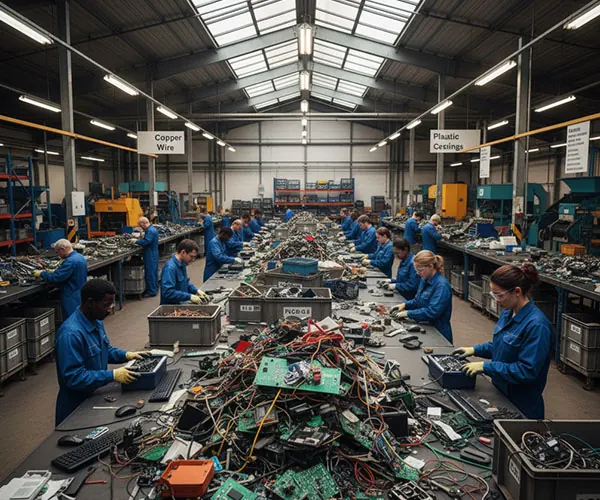
Every home and office in Singapore eventually ends up with a drawer of old phones, a tangle of cables, a dead laptop or a printer nobody uses. This is e-waste — and it is one of the most valuable, and most misunderstood, kinds of waste. Handled properly, most of it can be recovered and made into new products. Handled badly, it can leak harmful substances into the air, soil and water. Here's how e-waste is recycled the environment-friendly way, step by step.
What Counts as E-Waste?
E-waste is anything with a plug, a battery or a circuit board that has reached the end of its life. Common examples include:
- Computers, laptops, monitors, servers and networking equipment
- Mobile phones, tablets, chargers and power banks
- Cables and wires of all kinds
- Printers, photocopiers and other office electronics
- Household appliances such as TVs, washing machines, fridges and air-conditioners
- Batteries and lamps
Why It Matters
It's full of valuable materials. Electronics contain copper, aluminium, steel and small amounts of precious metals such as gold, silver and palladium. Recovering them means less mining of new ore, which saves energy and reduces emissions.
Some parts are hazardous. Batteries, old screens, fluorescent lamps and the refrigerants in fridges and air-conditioners can contain substances such as lead, mercury, cadmium and ozone-depleting gases. These must be removed and treated carefully, not crushed or burned with general waste.
It protects your data. Old computers, phones and hard drives often still hold business and personal information. Proper e-waste recycling includes making that data unreadable before anything is broken down.
How E-Waste Is Recycled, Step by Step
1. Safe collection
E-waste is collected by licensed operators and kept apart from general rubbish, so batteries and screens are not crushed in a compactor and nothing ends up in a landfill or incinerator by mistake.
2. Data destruction
Hard drives, phones and storage devices are wiped or physically destroyed so no personal or company information can be recovered.
3. Manual dismantling
Workers take the items apart by hand: batteries, toner cartridges, screens, circuit boards, cables and refrigerant-containing parts are removed first and sorted.
4. Removing hazardous parts
Batteries, lamps containing mercury, old CRT glass and refrigerant gases are sent to specialised facilities that can treat them safely instead of releasing them into the environment.
5. Shredding and separating
What remains is shredded into small pieces. Magnets pull out iron and steel, eddy-current separators lift out aluminium and copper, and air and water systems separate the plastics.
6. Recovering the materials
The sorted metals go to smelters and refiners to become raw material again; circuit boards are processed to recover copper and precious metals; clean plastics are recycled into new products.
What Happens When It Isn't Done Properly
When e-waste is dumped, burned in the open or broken apart crudely just to pull out copper, toxic fumes and heavy metals are released and most of the valuable material is lost. That is why Singapore regulates e-waste: since July 2021, an Extended Producer Responsibility (EPR) system under the Resource Sustainability Act has required that regulated electrical and electronic products are collected and handled by licensed parties, with the National Environment Agency (NEA) overseeing the system.
Simple Things You Can Do
Don't put electronics or batteries in the rubbish chute. Keep them aside for proper collection.
Back up and remove your data first, and ask your collector how storage devices will be handled.
Don't break items apart yourself. Cracked batteries, screens and lamps can be dangerous.
Use a licensed collector — see our guide Is Your Scrap Metal Dealer NEA-Licensed? for what to check.
How Omani Hardware Can Help
Omani Hardware Trading is an NEA Approved Contractor handling e-waste and cable recycling for homes, offices, factories and institutions across Singapore. We collect computers, servers, office electronics, appliances, cables and batteries, keep them separate from general waste, and send them on for safe, responsible recycling in line with NEA guidelines. See our Disposal Services and What We Buy pages for details.
Have old electronics or cables to clear?
Call, WhatsApp or email us — we collect anywhere in Singapore.
Call +65 8336 3639 WhatsApp Us Contact Us